
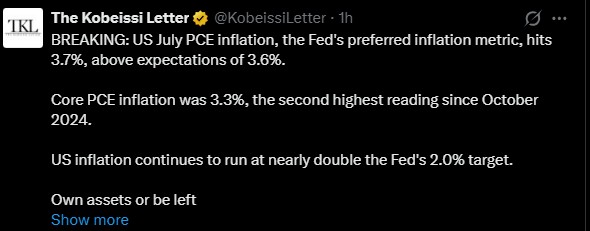
The July PCE inflation report came in hotter than expected on Wednesday. The headline reading rose 3.7% year over year, above the 3.6% forecast from economists.
The data adds fresh uncertainty to the Federal Reserve's next move on interest rates. Crypto traders were already watching the report closely before it landed.
What Happened With July PCE Inflation?
The Personal Consumption Expenditures price index, the Fed's preferred inflation gauge, rose 3.7% annually in July. Both the headline and core figures were 0.1 percentage point above the Dow Jones consensus.
The core PCE index, which excludes food and energy, held steady at 3.3% annually, matching expectations. On a monthly basis, both the headline and core PCE readings rose 0.2%.
The report, released by the Bureau of Economic Analysis, also included other economic details. Personal income grew 0.4% on the month, above the 0.3% forecast, while personal spending rose 0.2%.
Why Is This Report in the News Today?
The PCE index matters because the Fed uses it as a main tool for judging inflation trends. Policymakers watch it closely when deciding whether to raise or lower interest rates.
Inflation has stayed above the Fed's 2% target for some time. A hotter reading like this one keeps pressure on the central bank ahead of its next meeting.
Trading Economics data from August 2025 showed headline PCE inflation at 2.7% and core PCE at 2.9% during that period, showing how much price pressure has grown since then.
How Did the Crypto Market React?
Bitcoin was already trading with caution heading into the report. The largest cryptocurrency decline 1% on Wednesday to about $78,400, Ethereum down by 0.90%, XRP declined 4.70% to roughly $1.39, and Solana dropped 1.5% to about $96.54 in one snapshot taken ahead of the release. as of the writing, after pulling back from a recent high.
Bitcoin briefly broke through $81,000 on Tuesday before giving up gains as some investors moved to lock in profits from the biggest weekly advance in over three years.
The total crypto market capitalization fell about 1.6% to roughly $2.73 trillion, with 24-hour trading volume near $83.07 billion, according to CoinGecko data cited in that report.
Market reaction to the exact release moment was not yet fully confirmed across sources at the time of writing. Traders should treat any single price snapshot as a short-term data point rather than a full market verdict.
Background: Why This Report Carries Extra Weight
Bitcoin entered the final week of August trading near $77,000 after a 22% weekly gain, driven by a mix of factors. Treasury buybacks, a weaker dollar, strong spot ETF inflows, and more than $4 billion in short liquidations fueled the rally.
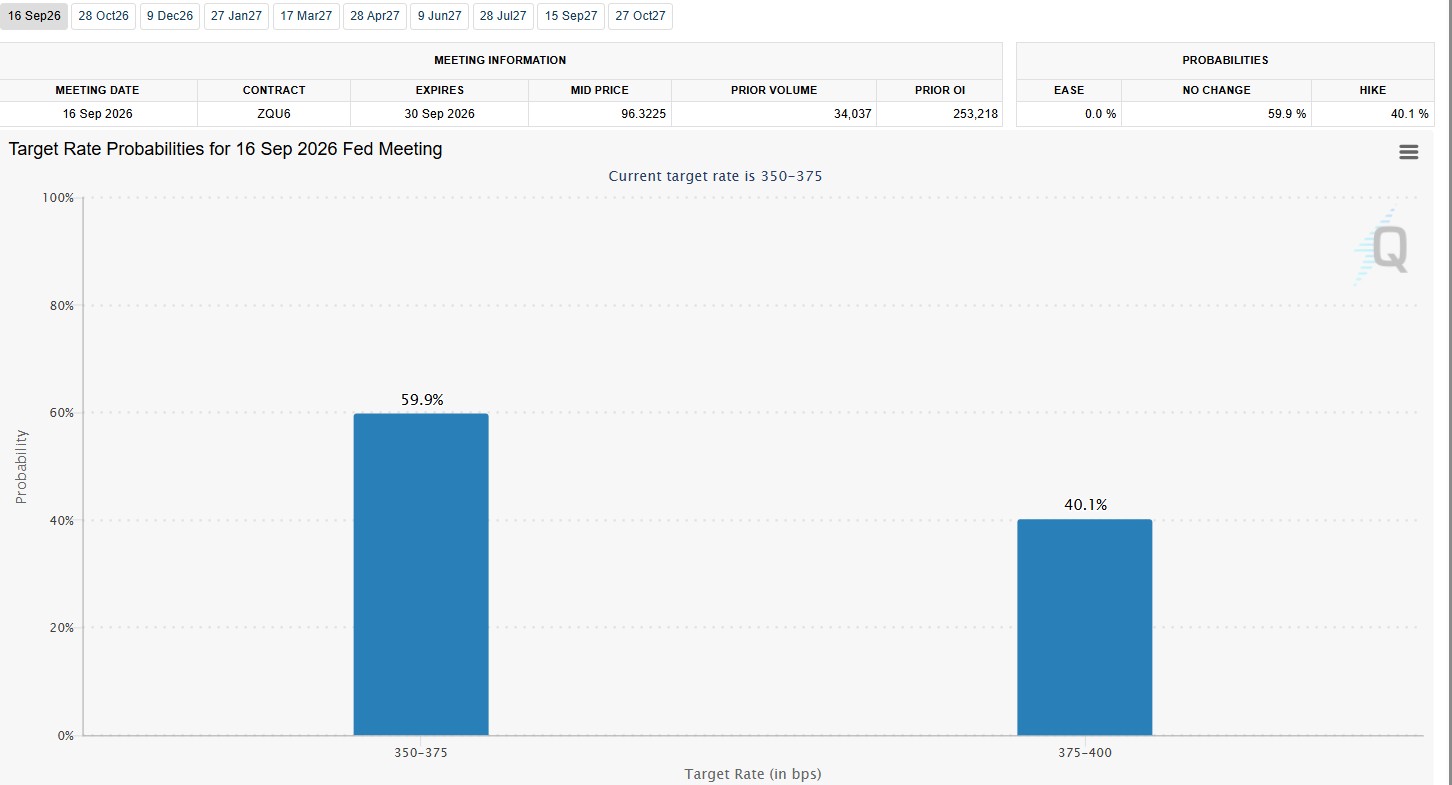
Rate expectations had already shifted heading into the report. CME's FedWatch tool priced a September rate hike at 40.10%, a sharp reversal from 82% a month earlier.
Bitcoin's momentum going into the release was also flagged as stretched. The 14-day Relative Strength Index reading above 79 suggested Bitcoin's rapid climb from roughly $63,000 to above $80,000 in a week had generated unusually strong upside momentum.
What Could This Mean for the Crypto Market?
A hotter inflation reading can support the case for the Fed holding rates higher for longer, or even raising them. That tends to weigh on risk assets, including crypto, since higher rates make safer, yield-bearing investments more attractive.
A hotter result could strengthen expectations that interest rates will remain elevated, potentially pushing bond yields and the dollar higher and weighing on Bitcoin. A softer reading may ease those pressures, though the market's response depends on the finer details of the report.
This is a general market pattern, not a guaranteed outcome. Crypto prices react to many factors at once, and inflation data is only one piece of that picture.
What Should Traders Watch Next?
Beyond July PCE inflation data, more catalysts are on the calendar. Fed Chair Kevin Warsh is set to deliver his first Jackson Hole keynote, and the symposium runs into the following days.
Analysts see $80,000 as key resistance for Bitcoin, with views ranging from a confirmed bear market bottom to a potential path toward $95,000 if $82,000 clears. These are analyst views, not confirmed outcomes.
Traders are also watching how ETF flows hold up. BTC ETF Data, US spot Bitcoin ETFs attracted more than $314.37 million on August 25, marking August 2026 as the strongest month for Bitcoin ETF inflows this year.
Conclusion
July PCE inflation came in above forecasts at the headline level, while core inflation matched expectations at 3.3%. Bitcoin held in a range near $78,400 in the hours around the release, following a sharp weekly rally.
The report adds another data point for the Fed's coming decisions, and for crypto traders trying to gauge the path of interest rates. As always, near-term price moves should be read with caution rather than certainty.
Financial Risk Disclaimer
This article is for informational purposes only and does not constitute financial advice. Cryptocurrency markets are highly volatile and carry significant risk. Always do your own research before making investment decisions.