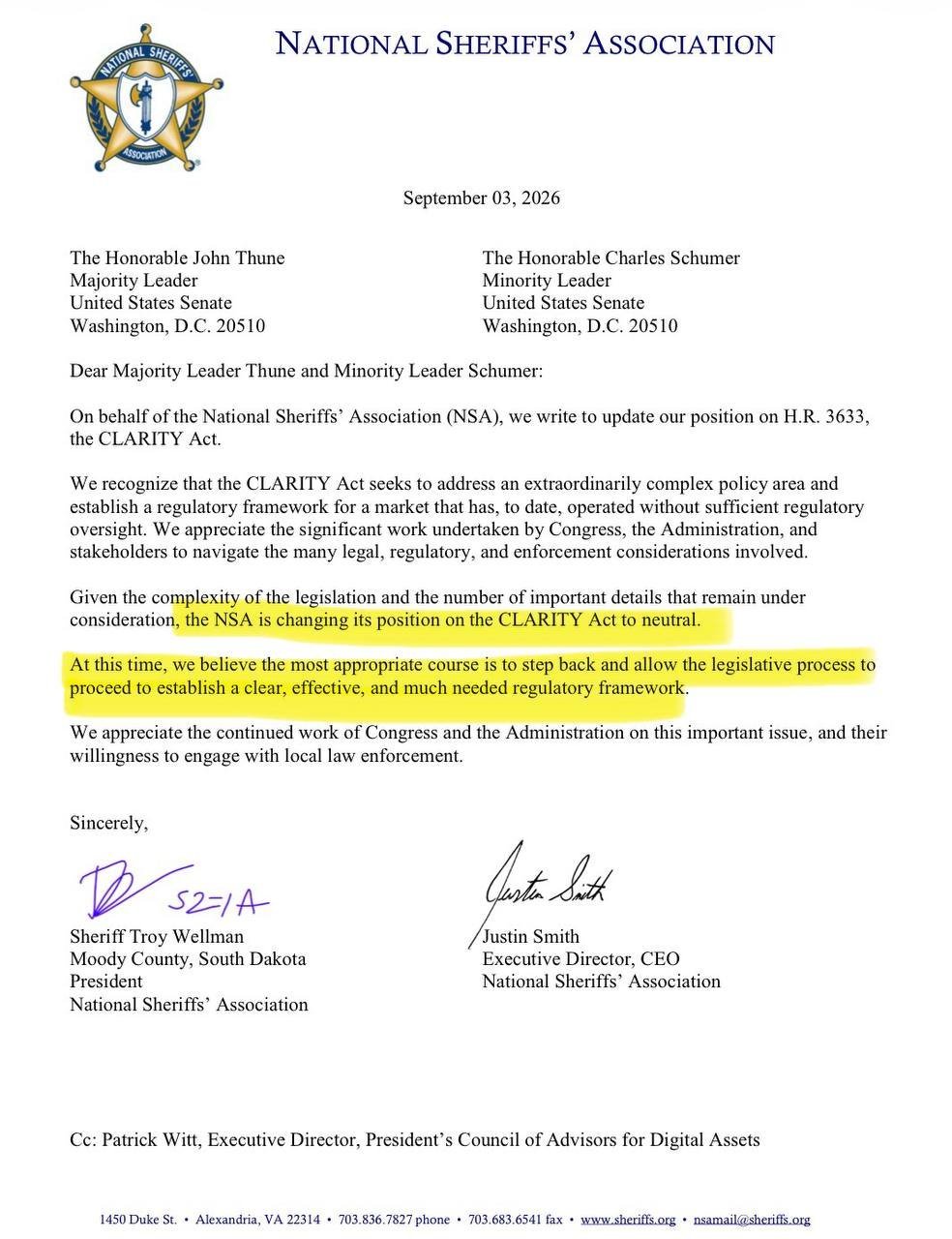
The National Sheriffs' Association (NSA) told Senate leaders in a September 3 letter that it is changing its position on the CLARITY Act, the digital asset market structure bill known formally as H.R. 3633, from opposition to neutral.
The letter, addressed to Senate Majority Leader John Thune and Minority Leader Chuck Schumer and signed by NSA President Sheriff Troy Wellman of Moody County, South Dakota, and NSA Executive Director and CEO Justin Smith, says the organization believes "the most appropriate course is to step back and allow the legislative process to proceed to establish a clear, effective, and much needed regulatory framework." A copy was sent to Patrick Witt, executive director of the President's Council of Advisors for Digital Assets.
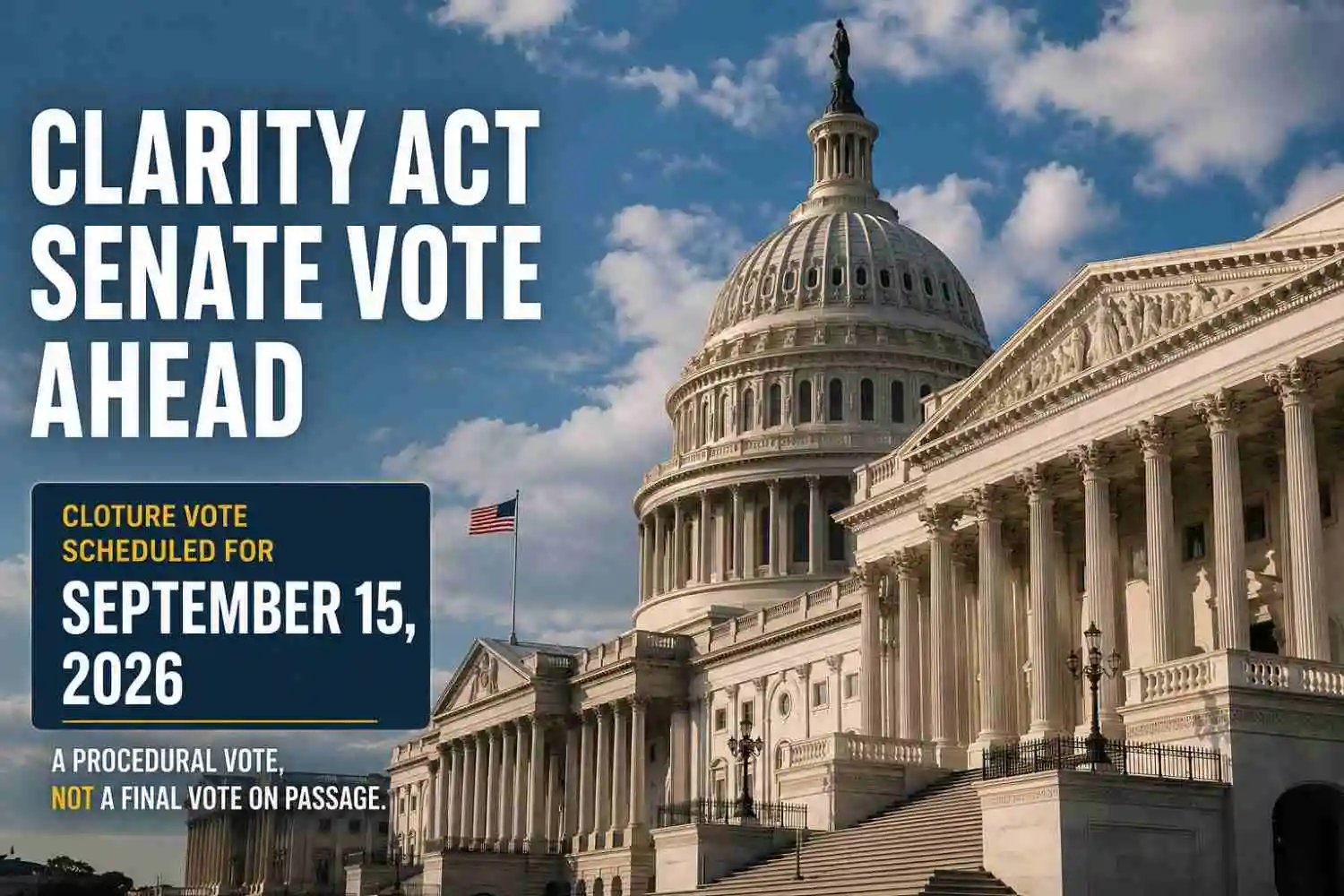
The shift comes roughly two weeks before the Senate is scheduled to hold a cloture vote on the bill on September 15, a procedural step that will determine whether the legislation can advance to floor debate this year.
WHAT HAPPENED
The National Sheriffs' Association, a national organization representing county sheriffs, sent a letter to the Senate's top two leaders announcing that it no longer opposes the CLARITY Act. The letter frames this as an update to a previous position, indicating the NSA had opposed the bill before this shift to neutrality. The letter does not specify what that earlier position was based on, and that information was not available in the source reviewed.
WHAT THE PRIMARY SOURCE SAYS
According to the letter, the NSA "recognizes that the CLARITY Act seeks to address an extraordinarily complex policy area and establish a regulatory framework for a market that has, to date, operated without sufficient regulatory oversight." The organization credits Congress, the administration, and stakeholders for their work on the bill's "legal, regulatory, and enforcement considerations."
The letter states that "given the complexity of the legislation and the number of important details that remain under consideration, the NSA is changing its position on the CLARITY Act to neutral." It goes on to say the organization believes the best course now is to "step back and allow the legislative process to proceed."
Importantly, the letter is a statement of institutional neutrality, not an endorsement. The NSA does not say it supports passage of the bill, and the letter does not detail which specific provisions previously concerned the organization or whether those concerns have been resolved. Readers should not interpret this letter as evidence the bill's underlying law enforcement provisions have changed.
RELEVANT CONTEXT
The CLARITY Act, formally the Digital Asset Market Clarity Act (H.R. 3633), would establish a framework dividing regulatory authority over digital assets between the Securities and Exchange Commission and the Commodity Futures Trading Commission. The bill was received in the Senate and referred to the Committee on Banking, Housing, and Urban Affairs in September 2025, and was reported out of that committee on June 1, 2026.
The House passed the CLARITY Act in July 2025 by a vote of 294-134. The Senate Banking Committee approved the measure 15-9 in May 2026 after months of negotiation.
The Senate adjourned for its August recess on August 8, 2026 without holding a final vote on the bill, but Majority Leader Thune filed cloture on the motion to proceed shortly before the recess began, setting up a procedural vote for September 15, 2026. That vote requires a 60-vote supermajority to succeed; if it fails, the bill's prospects for passage in 2026 would be significantly diminished. If the cloture motion does pass, the Senate would move to formal debate and a subsequent amendment and final-passage process.
Because the House and Senate versions of the bill differ, a conference committee would likely be needed to reconcile the two chambers' text before the legislation could go to the president.
Law enforcement groups have had a stake in the bill's provisions governing enforcement authority over digital asset markets, which is the likely basis for the NSA's earlier opposition, though the letter itself does not enumerate specific objections.
WHY IT MATTERS
A national law enforcement association removing formal opposition to a major financial regulatory bill can matter to lawmakers weighing how to characterize the bill's stakeholder support ahead of a close vote. The NSA's letter arrives close to the September 15 cloture vote, which several sources note is expected to be tightly contested given the 60-vote threshold.
That said, the letter's practical effect on the vote count is not established by the available evidence. The NSA's shift to neutral is not the same as an endorsement, and nothing in the letter indicates it is coordinating with any specific senator's office or vote-counting effort. Any characterization of this letter as securing new support for passage would go beyond what the document itself states.
RISKS AND UNCERTAINTY
The letter does not disclose what specific provisions of the CLARITY Act previously drove NSA opposition, nor whether the current bill text has been modified to address those concerns. That information was not available in the sources reviewed. Readers should also note that a cloture vote succeeding does not guarantee the bill becomes law; it only allows debate to proceed, and a conference process with the House would still be required.
WHAT TO WATCH NEXT
The Senate cloture vote is scheduled for September 15, 2026, at 2:15 p.m. ET, one day after the Senate reconvenes from recess. Whether the National Sheriffs' Association's shift to neutral is followed by similar moves from other law enforcement or financial industry groups may become clearer in the days leading up to that vote. Coverage should also watch for any Senate Banking Committee or leadership statements addressing outstanding disagreements over ethics provisions, DeFi treatment, and regulatory authority, which multiple sources have identified as sticking points.
CONCLUSION
The National Sheriffs' Association has moved from opposing the CLARITY Act to a neutral position, according to a September 3 letter to Senate leadership, as the chamber prepares for a September 15 cloture vote on the bill. The letter frames the shift as a decision to let the legislative process continue rather than as an endorsement of the bill's passage.