
Michael Saylor published a new essay called "The Bitcoin Reformation" in August 2026, arguing that Bitcoin is for everyone and should move beyond the founding-era rules that once defined its culture. The phrase "Bitcoin is for everyone" appears throughout the essay as its central message.
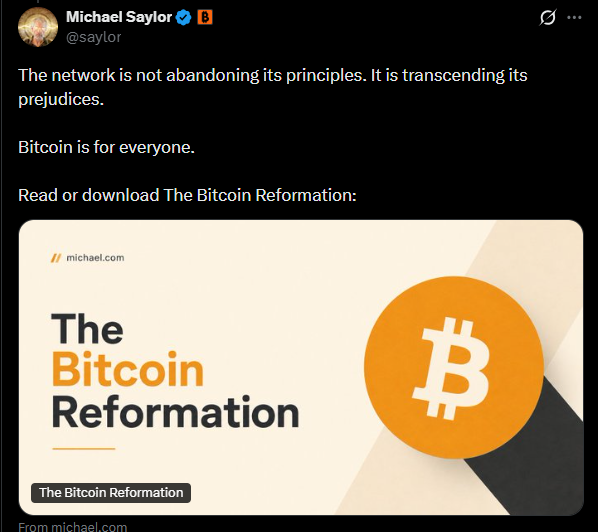
The paper, framed as a direct challenge to what Saylor calls "Bitcoin Orthodoxy," argues that ideas like mandatory self-custody, rejection of banks, and treating Satoshi Nakamoto's early writing as final law have become outdated. Saylor instead calls for a shift toward institutional integration, regulated custody, and financial products built around bitcoin.
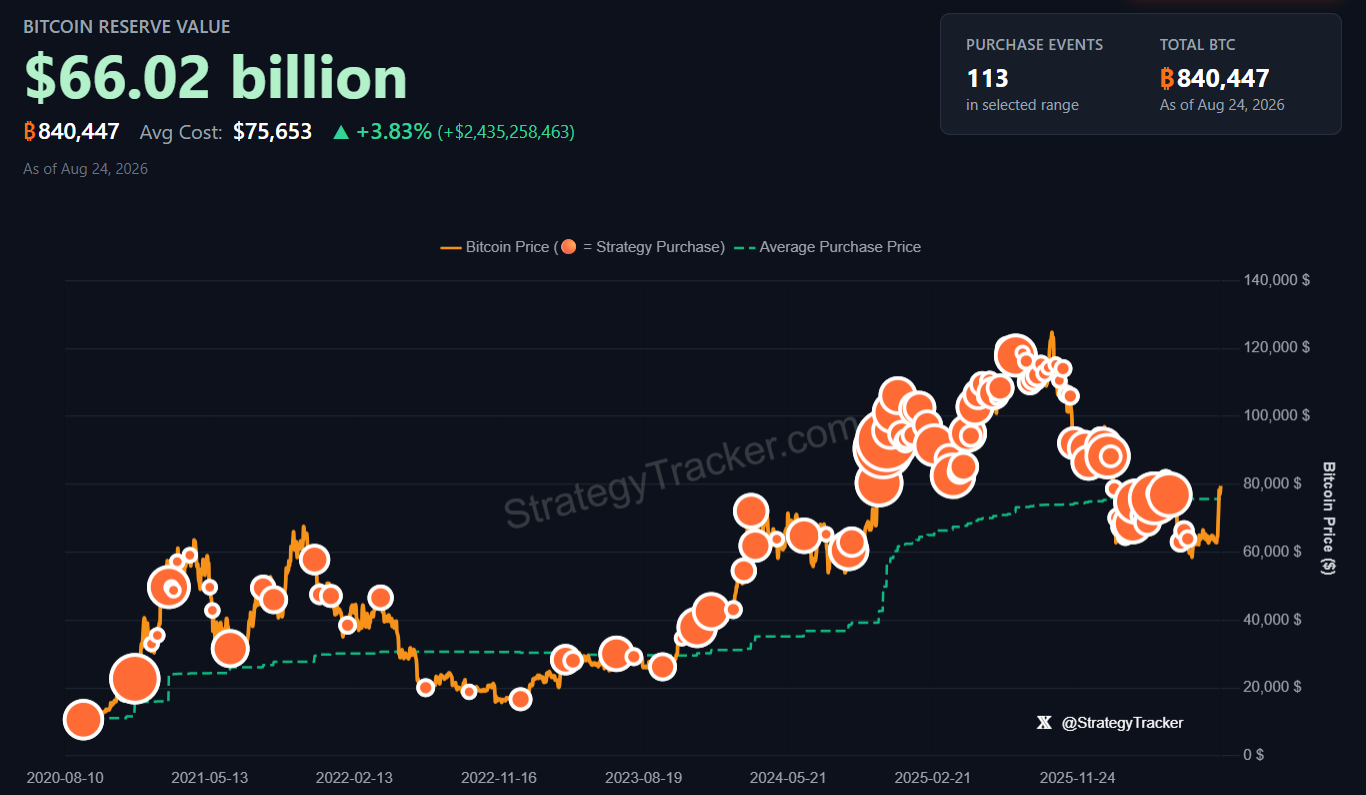
The essay comes as institutional bitcoin holdings continue to grow. Saylor's own company, Strategy, reported holding 840,447 bitcoin as of August 2026, while BlackRock's iShares Bitcoin Trust reported 734,261 bitcoin worth about $43.4 billion as of June 30, 2026.
What did Saylor argue in the essay?
Saylor argued that Bitcoin's early survival-era beliefs, such as treating self-custody as mandatory and viewing all institutions as illegitimate, should give way to what he calls "counterparty discrimination" rather than blanket distrust.
He wrote that self-custody remains an important right but should not be treated as a universal duty, since institutions, corporations, and governments have different operational needs than individual holders.
He also argued that securities tied to bitcoin, such as ETFs, corporate equity, and debt instruments, should not be dismissed together as "paper Bitcoin," since each carries different legal claims and risk profiles.
The underlying premise, Saylor wrote, is that Bitcoin is for everyone, not just holders who follow one custody model or one political view.
Why is this argument coming out now?
The essay references two recent events that Saylor uses to support his case: a security failure at hardware wallet maker Coldcard and the rejection of a Bitcoin protocol change known as BIP-110.
According to the essay, Coinkite disclosed in July 2026 that a firmware flaw caused some Coldcard devices to use a weaker fallback method for generating random numbers, cutting the effective security level far below its intended 128-bit target. Later public reporting, cited in the essay, put attributed losses above $100 million.
Saylor used the incident to argue that no device or ideology guarantees security by itself, and that professional custody and layered protections can reduce certain risks that pure self-custody does not address.
The essay also points to BIP-110, a proposed rule change meant to restrict certain types of data from being stored in Bitcoin transactions. The proposal's repository status was marked "Closed" on August 9, 2026, after the change caused a chain split and led to stalled mining, according to the essay. Saylor treats the outcome as proof that no single group can impose new rules on Bitcoin without broad adoption across miners, node operators, and exchanges.
What does the essay say about institutional adoption?
The essay lays out figures showing how large institutional Bitcoin holdings have become. Strategy's 840,447 bitcoin and BlackRock's 734,261 bitcoin together represent roughly 1.6 million bitcoin between the two entities alone, based on the dates cited in the essay.
|
Holder |
Bitcoin Held |
Value Cited |
As of Date |
|
Strategy |
840,447 BTC |
Not specified in essay |
August 2026 |
|
iShares Bitcoin Trust (BlackRock) |
734,261 BTC |
~$43.4 billion |
June 30, 2026 |
Saylor also cited market-size figures to argue Bitcoin has room to grow as an asset class. The essay references a SIFMA estimate putting global equity market capitalization at approximately $157.8 trillion and global fixed-income securities outstanding at approximately $160.7 trillion for 2025, along with a World Gold Council estimate of roughly $15 trillion for the investible gold market.
What could this mean for the crypto market next?
The essay does not predict a bitcoin price target. Instead, it argues that continued integration with banks, custodians, corporations, and regulators is likely to expand the pools of capital that can access bitcoin, citing regulatory moves such as the SEC's January 2024 approval of spot bitcoin ETPs and 2025 guidance from the OCC and other banking regulators on crypto custody.
Saylor frames the next phase of Bitcoin's development around what he calls "digital capital," a layered structure that could include bitcoin-backed equity, credit, debt, and even autonomous machine transactions.
Whether that structure materializes will depend on continued cooperation between regulators, custodians, and the broader crypto market rather than any single announcement.
What are people watching now?
Market participants are likely to watch how custody regulation develops, how large holders like Strategy and BlackRock continue to report their positions, and whether future Bitcoin protocol proposals face the same adoption hurdles that BIP-110 did in August 2026.
Saylor closes the essay by repeating his core claim that Bitcoin is for everyone, regardless of profession, politics, or technical skill.