Quantum computers threaten to break the cryptography that secures nearly every blockchain in use today. Quanchain is a project built specifically to address that risk. Rather than relying on one-time upgrades, it aims to adjust its cryptographic security automatically as quantum computing capability grows. This article breaks down what Quanchain is, how its technology works, and why the quantum threat matters for crypto holders now, not just in some distant future.
What Is Quanchain?
Quanchain describes itself as the first blockchain that automatically upgrades its cryptography as quantum computers become more powerful. Instead of treating quantum resistance as a single migration event, the project frames it as an ongoing process. According to Quanchain's own materials, its architecture recalibrates security levels in response to real-world quantum threat data, rather than waiting for a crisis to force a hard fork.
The project is still in an early, research-driven stage. Its public roadmap moves through research, protocol design, testnet, and mainnet phases, with a public testnet featuring a small validator cluster already live. That timeline matters. As a result, readers should treat Quanchain as an emerging infrastructure project rather than an established network with years of production history.
Why Quantum Computing Threatens Blockchains
Most blockchains, including Bitcoin and Ethereum, secure wallets with cryptography that a sufficiently powerful quantum computer could theoretically break. Researchers often refer to the point at which this becomes practical as "Q-Day." Estimates vary, however Quanchain's own analysis places it around mid-2028, earlier than some industry consensus figures near 2029.
The deeper problem isn't the single cutoff date. It's what happens afterward. When a network updates its encryption, some wallets inevitably fail to migrate in time. Quanchain estimates that historically, roughly 20% of wallets miss each upgrade window. Once quantum capability exists, those unmigrated balances become vulnerable to theft, and old "Satoshi-era" addresses that can never be moved would remain exposed indefinitely.
This is not a fringe concern. NIST, the U.S. standards body, finalized its first post-quantum cryptography standards in 2024, signaling that governments and enterprises already treat the transition as a near-term priority rather than a theoretical exercise.
How Quanchain's Technology Works
Dynamic Security Levels
Quanchain uses a system of 20 security levels with variable-length address hashing, so wallets can step up their cryptographic strength as threat conditions change. A permanent "Level 20" parent identity anchors this system using composite ML-DSA-87 and SLH-DSA-SHA2-256f signatures, which are the production names for algorithms formerly known as Dilithium-5 and SPHINCS+-256f. Both are part of the NIST post-quantum standards (FIPS 204 and 205).
The Quantum Threat Oracle
Rather than issuing a simple safe-or-danger signal, Quanchain's Quantum Threat Oracle uses a seven-level threat scale, similar to a hurricane category system. It monitors global quantum computing progress and informs the network when it's time for wallets to step up their protection level, aiming to make upgrades proactive rather than reactive.
Proof of Coherence Consensus
Validators on Quanchain are selected through a mechanism the project calls Proof of Coherence. It combines staked tokens with performance metrics like uptime and response accuracy, so a smaller, reliable validator can outcompete a larger but inconsistent one. Validators who adopt higher security levels early receive bonus rewards, which is designed to encourage the network to harden itself ahead of need rather than under pressure.
Throughput and Performance
The project states its architecture uses independent parallel processing pipelines to avoid cross-domain contention, targeting throughput above 200,000 transactions per second with roughly 400ms block times. As with any pre-mainnet project, these figures come from Quanchain's own technical documentation and haven't yet been independently verified at scale in production.
Quanchain Tokenomics
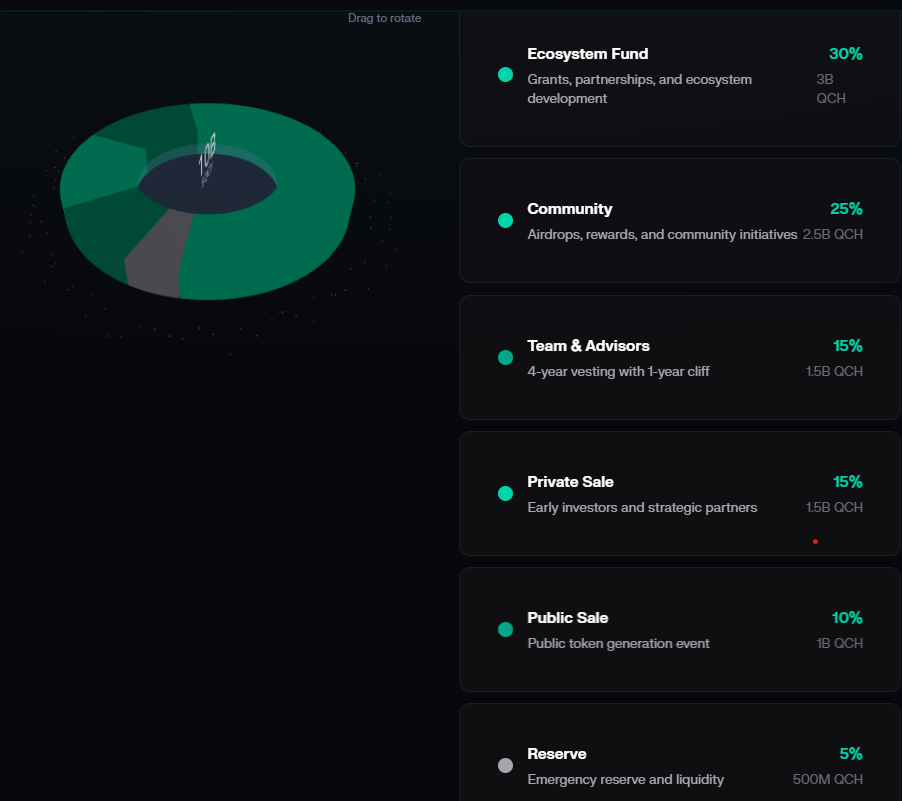
Quanchain's published token model outlines a fixed total supply of 10 billion tokens, distributed as follows:
-
Ecosystem Fund – 30% (3B tokens): Grants, partnerships, and ecosystem development
-
Community – 25% (2.5B tokens): Airdrops, rewards, and community initiatives
-
Team & Advisors – 15% (1.5B tokens): Subject to a 4-year vesting schedule with a 1-year cliff
-
Private Sale – 15% (1.5B tokens): Allocated to early investors and strategic partners
-
Public Sale – 10% (1B tokens): Reserved for the public token generation event
-
Reserve – 5% (500M tokens): Held for emergency reserve and liquidity needs
The project also lists a dynamic fee structure and cites an approximate 12% staking yield. As with any early-stage token model, allocation percentages and yield figures can change before or after a token generation event, so this shouldn't be treated as a guarantee. Anyone considering acquiring tokens should independently verify current figures directly on Quanchain's official channels and consult a financial professional, since this article is informational and not financial advice.
For more crypto news, visit: https://bestcryptopresales.com/crypto-presale-news
For more crypto blogs, visit: https://bestcryptopresales.com/crypto-presale-blogs