
LIVE
BTC $73,515 ▼ 0.45% ETH $2,008 ▼ 0.68% BNB $725 ▲ 6.87% SOL $81.97 ▼ 0.57% XRP $1.33 ▼ 0.66% DOGE $0.099 ▼ 1.16% ADA $0.234 ▼ 0.66% AVAX $8.90 ▼ 0.61% LINK $9.10 ▼ 0.83% HYPE $68.13 ▲ 0.57% ONDO $0.355 ▲ 3.00% TON $1.86 ▲ 5.20% BTC $73,515 ▼ 0.45% ETH $2,008 ▼ 0.68% BNB $725 ▲ 6.87% SOL $81.97 ▼ 0.57% XRP $1.33 ▼ 0.66% DOGE $0.099 ▼ 1.16%
Presale News

Cynthia Lummis Stablecoins Community Banks Deposit Claims Debunked

By Smith Bourbon August 11, 2026
Senator Cynthia Lummis speaking on stablecoins and community bank deposits

Cynthia Lummis Stablecoins Community Banks Debate: What The Data Shows

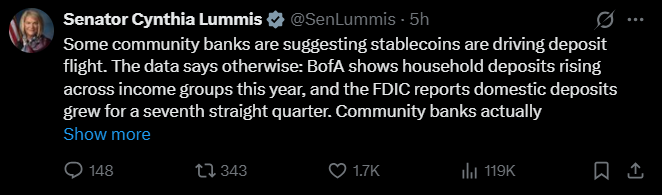
Senator Cynthia Lummis is pushing back against a growing claim in banking circles. Some community banks say stablecoins are pulling deposits away from them. Lummis says the numbers tell a different story.

Cynthia Lummis Stablecoins Community Banks concerns have grown louder as Congress works through the CLARITY Act, a bill meant to set clear rules for digital assets.

Lummis argues the data does not support the deposit flight theory at all.
What Does The Deposit Data Actually Show?

Bank of America reported household deposits rising across income groups this year. That includes lower and middle income households, not just wealthy accounts.

The FDIC also reported something notable. Domestic deposits grew for a seventh straight quarter, according to Lummis.

Community banks did not lag behind either. Lummis said they actually outperformed the broader industry, posting 5% deposit growth.

That number stands out. If stablecoins were truly draining small bank deposits, growth like that would be hard to explain.

Does The CLARITY Act Make Stablecoins Riskier For Banks?

Some critics worry the CLARITY Act itself opens the door for stablecoins to compete with bank deposits. Lummis says that reading is backwards.

She points to Section 404 of the bill. It bars stablecoin issuers from paying anything that functions like interest. That includes disguised rewards or points programs.

The section also bans marketing stablecoins as deposits or as FDIC insured products.

Lummis argues this makes the rules tougher than current law, not looser. Under her framing, stablecoin issuers would face more restrictions than they do today.

What Is Really Behind Community Bank Closures?

Lummis points to a separate trend as the real driver of community bank struggles. It is consolidation, not crypto.

Over the past decade, roughly 2,000 community banks have disappeared. Only 62 new ones formed in that same period.

The banks buying up smaller institutions are mostly super regional banks. They are not crypto companies entering the banking business.

That gap between banks lost and banks formed has been building for years, long before stablecoins became a mainstream topic.

What Is Congress Doing To Help Community Banks?

The Senate Banking Committee has already built support measures into a housing bill. Lummis said it includes nine provisions aimed at community bank deposit retention.

The same package also tightens stablecoin yield rules further, building on the restrictions already in the CLARITY Act.

Lummis frames the combination as an attempt to address both sides of the concern at once.

Lummis: Killing The Bill Protects A Broken System

Lummis closed her argument with a direct warning. She said killing the CLARITY Act will not help community banks recover.

Instead, she said it would simply protect the status quo, the same system that critics themselves call broken.

The comments add to an ongoing back and forth in Washington over how stablecoins should be regulated, and who actually benefits from delaying that regulation.

The Cynthia Lummis Stablecoins Community Banks discussion is likely to continue as the CLARITY Act moves closer to a final vote.

Community Bank Deposit Snapshot

Metric

Data Point

FDIC domestic deposit growth

7 consecutive quarters

Community bank deposit growth

5%

Community banks lost (10 years)

~2,000

New community banks formed

62

Main buyers of small banks

Super regional banks

CLARITY Act provision on yield

Section 404

Housing bill community bank provisions

9

Frequently Asked Questions

Lummis said deposit data contradicts claims that stablecoins are causing deposit flight, pointing to FDIC and BofA growth figures instead.

No, Section 404 of the CLARITY Act bars stablecoin issuers from paying interest or disguised rewards, making rules stricter than current law.

Lummis blames consolidation, noting 2,000 community banks disappeared in a decade while only 62 new ones were formed nationwide.

Data cited by Lummis shows community banks posted 5% deposit growth, outperforming the broader banking industry this year.

The Senate Banking Committee added nine community bank provisions to a housing bill, plus tighter stablecoin yield restrictions.
Tags: Cynthia Lummis stablecoins community banks CLARITY Act stablecoin regulation community bank deposits FDIC deposit data bank consolidation crypto legislation stablecoin yield ban Section 404 CLARITY Act digital asset policy US Senate banking committee stablecoin issuers interest ban
Smith Bourbon

Smith Bourbon is an experienced crypto news writer and editor specializing in macroeconomics, cryptocurrency policy and regulation, and the evolving relationship between DeFi and traditional finance. With three years of experience covering financial markets, Smith has developed a reputation for thorough research, sharp market analysis, and clear, engaging journalism. His work focuses on breaking down complex financial developments and turning fast-moving market events into informative stories for readers. Smith covers a broad range of topics, including crypto markets, regulatory developments, macroeconomic trends, AI and blockchain innovation, and the growing convergence of decentralized and traditional financial systems. He is particularly focused on providing timely updates, independent analysis, and meaningful context behind the headlines. Driven by a passion for financial markets and emerging technologies, Smith continues to explore the forces shaping the global economy and digital asset industry while delivering accurate, insightful, and reader-focused reporting.

Why Readers Trust BestCryptoPresales

We've covered crypto presales and blockchain news since 2026. Our content is produced by a panel of analysts and journalists who follow editorial guidelines built around Experience, Expertise, Authoritativeness, and Trustworthiness (E-E-A-T). This is YMYL content ("Your Money or Your Life"), meaning it can affect real financial decisions, so we hold it to a higher standard than typical blog content. Our writers verify claims against public sources before publishing, and we correct mistakes when we find them. Sponsors do not dictate our coverage. If you read something here, it's because we believe it's accurate at the time of publication, not because someone paid for a favorable review.


Investment Disclaimer: What you read here is opinion, not financial advice. Crypto is volatile, and presale projects especially can lose most or all of their value. Talk to a licensed financial advisor before putting real money in. We're not responsible for what you decide to do with your own funds.

Ad Disclosure: Some links on this site are affiliate links, and some content is sponsored. We label sponsored content when it appears. Sponsors don't get to edit our opinions.

Add as a preferred source on Google