
Bitcoin BIP-110 Fork Fails as Network Keeps 99.85% of Hashpower
Bitcoin just went through a real test. A group of miners tried to split the network with a new rule called BIP-110. Most of the network did not follow.
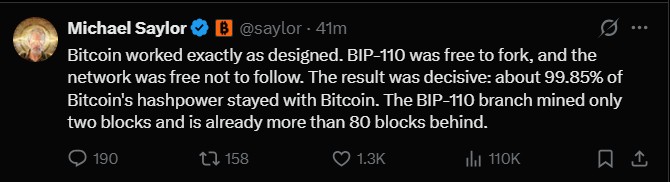
Michael Saylor, executive chairman of Strategy, shared the result on X. He said BTC worked exactly as it was designed to work.
What happened with the BIP-110 fork?
BIP-110 was a proposed soft fork. It aimed to limit non-payment data on Bitcoin, like inscriptions and Ordinals, from clogging up blocks.
Supporters wanted miners to signal support before a set block height. The plan needed a 55% threshold to lock in smoothly.
That threshold was never close. Signaling stayed under 3% for weeks, according to earlier reports from Bitcoin.com and Decrypt.
How much hashpower did Bitcoin keep?
Once the mandatory signaling window opened, BIP-110 nodes began rejecting blocks that did not carry their signal. This split the chain into two paths.
The numbers show a clear result. About 99.85% of Bitcoin's hashpower stayed on the main chain, based on Saylor's post.
The BIP-110 branch only mined two blocks after the split. It fell more than 80 blocks behind the main Bitcoin chain soon after.
|
Metric |
Main Bitcoin Chain |
BIP-110 Branch |
|
Hashpower share |
~99.85% |
~0.15% |
|
Blocks mined after split |
Full pace |
2 blocks |
|
Blocks behind |
0 |
80+ |
Why did the fork fail so quickly?
Big mining pools simply did not join. Reports before the split showed Foundry, AntPool, F2Pool, and ViaBTC had not signaled support at all.
Without major miners, a minority chain cannot keep up in block production. That is exactly what played out here.
Saylor had spent weeks pushing back on the proposal. He published a long essay calling for neutral rules instead of rules that judge transaction purpose.
What does this mean for BTC users?
For most people, nothing changes. Exchanges, wallets, and ETF holders stay on the main Bitcoin chain without any action needed.
Only self-custody users running special software tied to BIP-110 face any risk, mainly around replay protection on the minority chain.
The bigger picture is about governance. BTC showed that a small group cannot force a rule change without broad miner support.
Bitcoin price and market reaction
Bitcoin's price did not show major swings tied to the fork news. Market watchers noted the event was widely expected after weeks of low signaling data.
Analysts say this kind of split, where one side simply falls behind, is a normal outcome for proposals that lack wide consensus.
Final thoughts
The BIP-110 episode adds to Bitcoin's long history of contentious proposals. The network absorbed the disagreement without any disruption to normal users.
Saylor framed it simply: forking was allowed, and the network was free to ignore it. That is how Bitcoin's rules are meant to work.